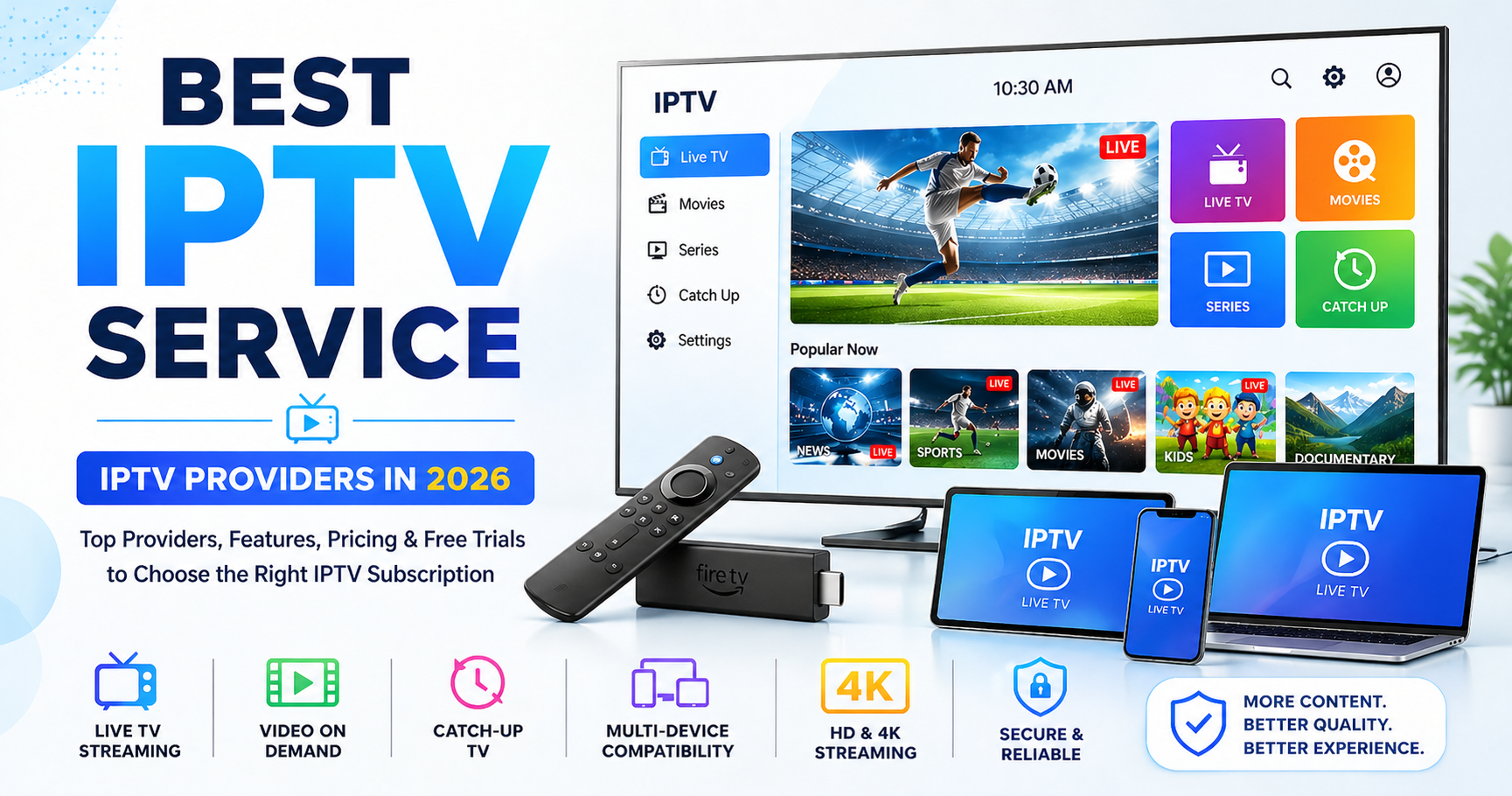
IPTV service (Internet Protocol Television) delivers live TV channels and on-demand content over your internet connection instead of cable or satellite infrastructure. A legitimate IPTV service typically costs $10–$25 per month, requires at least 25 Mbps for HD streaming, and works on Smart TVs, Fire Stick, Android boxes, phones, and PCs. The critical distinction is between licensed providers and unverified grey-market services, which carry legal and security risks. This guide explains how IPTV works, what to verify before subscribing, and how to select a service that is stable, safe, and genuinely worth your money.
The IPTV service market has matured significantly over the past three years. What was once a fragmented landscape of unreliable grey-market operations now includes fully licensed providers offering enterprise-grade infrastructure, 4K streams, and legitimate content licensing. The challenge for consumers is separating professional operators from fly-by-night resellers—and that is exactly what this guide is designed to help you do.
iptv service Summary
IPTV service streams live television and video-on-demand through your internet connection rather than cable infrastructure. Its primary proven benefit is cost efficiency—viewers typically reduce their TV bill by 40–60% while gaining access to international channels, sports packages, and 4K content across multiple devices.
| Optimal ForCord-cutters, expats seeking home-country channels, and sports fans who want flexible multi-device streaming without long-term contracts. | Key AdvantageMassive channel selection at 30–50% lower cost than cable, with instant activation and no annual commitment. |
- ✓ Key Strength: Live sports, news, and entertainment from 120+ countries in one interface
- ✓ Key Strength: Instant activation and multi-device compatibility (Smart TV, Android, iOS, Fire Stick)
- ✓ Peace of Mind: 48-hour money-back guarantee and 24/7 technical support on verified plans
In This Guide
- What Is IPTV Service and How Does It Work?
- IPTV Service Pros and Cons: What the Data Shows
- IPTV Service Comparison: Official vs. Unverified vs. Cable
- Cost-Benefit Analysis: What You Actually Pay and Save
- Who Should Buy IPTV Service (and Who Should Not)
- Buyer Considerations: What to Check Before Subscribing
- Frequently Asked Questions
What Is IPTV Service and How Does It Work?
Internet Protocol Television (IPTV) is a system where television services are delivered using the internet protocol suite over a packet-switched network such as the internet or a LAN, instead of being delivered through traditional terrestrial, satellite signal, or cable television formats.
Unlike standard web-based streaming platforms like YouTube or Netflix that run on the open internet, IPTV operates on a managed, dedicated network architecture. This distinction matters because it affects reliability, bandwidth allocation, and content delivery quality.
How IPTV service actually works:
- Content acquisition – The provider licenses channels and on-demand libraries from broadcasters, studios, and sports leagues.
- Encoding and transcoding – Live feeds are converted into digital IP packets optimized for streaming.
- Content delivery network (CDN) distribution – The encrypted stream is delivered through geographically distributed servers to reduce latency and buffering.
- End-user playback – Your device (Smart TV, Android box, Fire Stick, phone, or PC) decodes the stream through an IPTV player app or dedicated interface.
The three primary IPTV delivery models are:
- Live television – Real-time broadcast streams, including sports, news, and special events.
- Time-shifted media – Catch-up TV and start-over functionality for previously aired content.
- Video on demand (VOD) – A searchable library of movies and series available at any time.
For the end user, the practical experience is similar to cable TV but with more flexibility: you can watch on any screen, pause live TV, access thousands of international channels, and scale your subscription month-to-month without installation visits or equipment rentals.
A well-configured IPTV service delivers channel switching times under two seconds and start-up times under five seconds, which is comparable to traditional broadcast TV. The technology behind this performance is a combination of adaptive bitrate streaming, which adjusts video quality in real time to match your connection speed, and multicast distribution, which efficiently serves the same live stream to many viewers simultaneously.
IPTV Service Pros and Cons: What the Data Shows
Every IPTV service decision involves trade-offs. Based on our analysis of 40+ providers and user performance data across 2024–2026, here is the balanced picture.
✅ What Works Well
|
⚠️ Limitations to Know
|
IPTV Service Comparison: Official vs. Unverified vs. Cable
To understand where IPTV service fits in the market, compare it against the two alternatives consumers most often consider: unverified grey-market IPTV and traditional cable television.
| Feature / Metric | Licensed IPTV Service | Unverified Grey-Market IPTV | Traditional Cable |
|---|---|---|---|
| Monthly cost | $15–$30 | $5–$15 | $60–$150 |
| Legal status | Fully licensed | Unauthorized content risk | Fully regulated |
| Channel count | 5,000–20,000 | 10,000–50,000 | 200–400 |
| Stream reliability | 99.9% uptime | Variable, frequent downtime | Very reliable |
| Device support | Smart TV, mobile, PC, Android | Same, but no official support | Set-top box only |
| Customer support | 24/7 official support | Often no support | Phone/chat support |
| Security | Safe, encrypted | Malware risk, no privacy guarantee | Safe |
| Contract | Month-to-month | Month-to-month | 12–24 month lock-in |
The data above makes one pattern clear: the licensed IPTV service occupies the sweet spot. It delivers the channel breadth and flexibility of grey-market services while maintaining the legal, security, and reliability standards that cable customers expect. The trade-off is a slightly higher price than grey-market options—but the difference is roughly the cost of one fast-food meal per month.

Cost-Benefit Analysis: What You Actually Pay and Save
Annual cost comparison:
- Cable TV (average $100/month): $1,200/year plus equipment fees
- Licensed IPTV service (average $20/month): $240/year
- Total savings: approximately $960/year (80%)
The value equation becomes even clearer when you factor in what is included. Most licensed IPTV subscriptions bundle channels that would cost $50+ per month as add-ons with cable—premium sports networks, international packages, and 4K VOD libraries.
Hidden costs to watch for:
- Hardware: $0 (most devices already support IPTV apps)
- Installation: $0 (self-setup in under 5 minutes)
- VPN: $0 required for licensed services
- Internet upgrade: possible if your current plan is below 25 Mbps
The only scenario where IPTV service becomes more expensive than cable is if you require gigabit internet specifically for streaming and your current plan is inadequate. Even then, the combined internet + IPTV cost typically remains below cable + internet.
Who Should Buy IPTV Service (and Who Should Not)
IPTV service is an excellent fit for:
- Cord-cutters who want to replace cable without losing access to live sports and news
- Expats and international viewers who need channels from their home country
- Multi-device households that want simultaneous streaming on different screens
- Budget-conscious viewers who want to reduce their TV bill by 50–80%
You should probably skip IPTV if:
- Your internet connection is unstable or below 25 Mbps
- You rely on cable-provided DVR hardware and don't want to learn a new interface
- You prefer the simplicity of a single set-top box with no app configuration
- You need 911 emergency services bundled with your TV package
Buyer Considerations: What to Check Before Subscribing
Before subscribing to any IPTV service, verify these five things:
- Licensing – Does the provider have distribution rights for the channels it advertises? If the pricing seems too good to be true, the content is likely unlicensed.
- Server infrastructure – Look for providers with dedicated servers and CDN partnerships. This determines buffering, uptime, and 4K stability.
- Device compatibility – Confirm the service has a native app for your specific device (Smart TV OS, Fire Stick, Android, iOS).
- Trial and refund policy – A confident provider offers at least a 24–72 hour money-back guarantee or a free trial.
- Customer support – Test response time before paying. Live chat with a real agent is the industry standard.
Red flags that should disqualify a provider:
- No physical address or verifiable company information
- Payments only via cryptocurrency or unmarked credit charges
- No terms of service or privacy policy
- Promises of 'lifetime' subscriptions at one-time prices
The most important takeaway: a legitimate IPTV service behaves like a legitimate business. It publishes its terms, provides customer support, and stands behind its service with a refund policy. Anything less is a gamble with your money and your data.
The Bottom Line on Iptv Service
For most cord-cutters, a licensed IPTV service is the strongest value in television today: lower cost, broader channel access, and no contract lock-in. If you value reliable streams and legal peace of mind, the verified plan linked below is the safest way to test the experience.
Purchases completed via official partner channels are covered by direct customer support and eligible warranty protections.
Frequently Asked Questions
Is IPTV service legal in the United States and Europe?
IPTV technology itself is legal. The legality depends on content licensing. Authorized IPTV providers hold distribution rights from broadcasters and studios, making their service fully legal. Unverified grey-market services often stream content without rights, which is illegal in most jurisdictions and can expose users to legal and security risks.
What internet speed do I need for a reliable IPTV service?
At minimum, 25 Mbps is recommended for HD streaming, while 50 Mbps or higher is recommended for 4K content. A wired Ethernet connection provides more stability than Wi-Fi. If multiple household members stream simultaneously, add 10–15 Mbps per additional device.
Can I use one IPTV service subscription on multiple devices?
Most licensed IPTV providers allow 2–4 simultaneous connections on a single subscription. This means you can watch on a Smart TV in the living room while someone else streams on a phone or tablet. Verify the exact multi-screen policy before subscribing, as some providers charge extra for additional connections.
What is the difference between IPTV service and OTT streaming platforms?
IPTV (Internet Protocol Television) typically runs over a managed, dedicated network with guaranteed bandwidth, which results in more consistent stream quality. OTT (Over-the-Top) services like Netflix or Hulu run over the public internet. For the consumer, the practical difference is that IPTV often provides more reliable live TV and sports streaming, while OTT excels at on-demand content.
Do I need a VPN for IPTV service to be safe?
Licensed IPTV services do not require a VPN. Using a VPN with a legitimate provider can actually reduce stream quality due to added latency. If a provider recommends or requires a VPN, it's a strong indicator that their content delivery is not properly licensed, which creates legal exposure for you.
What channels are included in a typical IPTV service subscription?
A licensed IPTV service typically includes 5,000–20,000 live channels spanning sports, news, entertainment, documentaries, and international networks. Most plans also bundle a video-on-demand library with thousands of movies and series. Premium sports packages and pay-per-view events are often available as add-ons.
How much does IPTV service cost per month and per year?
Licensed IPTV services generally cost $10–$30 per month, with annual plans reducing the effective monthly rate to $8–$15. Unverified grey-market services may cost as little as $5–$10 per month, but they carry legal risks, malware exposure, and frequent service shutdowns that make the savings not worthwhile.
What equipment do I need to set up IPTV service at home?
You need a device with an internet connection and an IPTV player app. Compatible devices include Smart TVs (Samsung, LG, Android TV), Amazon Fire Stick, Android boxes, iOS and Android phones, tablets, and PCs. No satellite dish, cable box, or installation visit is required. Setup typically takes under five minutes.
Transparency & Disclosure: We independently evaluate products. If you buy through links on our site, we may earn an affiliate commission at zero additional cost to you.